
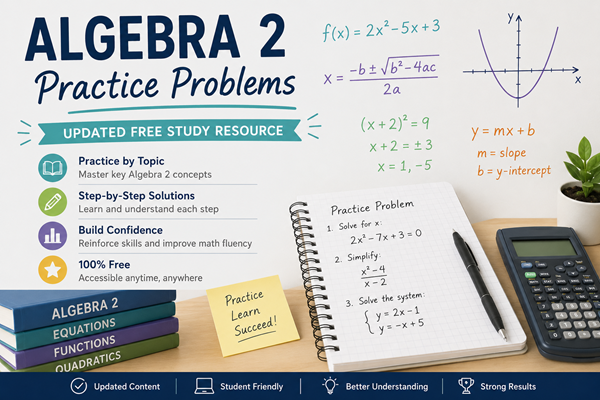
Algebra 2 is where mathematics starts to separate students who have a strong foundation from those who don’t. The concepts introduced at this level – quadratic functions, logarithms, matrices, and complex numbers – form the backbone of nearly every advanced math and science course that follows.
If you’re preparing for an upcoming exam, brushing up before college, or simply trying to build genuine confidence with the material, having the right practice resource makes all the difference.
This free guide from allstuguide.com is one of the most comprehensive Algebra 2 practice tools available online. It covers every major topic in the standard Algebra 2 curriculum through a structured, chapter-by-chapter format designed for both beginners and students working toward exam-level mastery.
What the Guide Covers
The resource spans eight content chapters, each built around a specific topic cluster. Rather than dumping problems onto a page without context, each chapter opens with a concept review and a formula reference table before moving into graded practice problems. That structure makes it useful not just as a problem set, but as a lightweight study companion when you need a quick refresher before diving into exercises.
The eight chapters cover: Quadratic Equations and Functions, Polynomial Operations and Factoring, Radical and Rational Expressions, Exponential and Logarithmic Functions, Systems of Equations and Matrices, Sequences and Series, Complex Numbers, and a Mixed Review chapter that pulls from all topics simultaneously. A consolidated answer key appears in Chapter 9.
Quadratic Equations and Functions
Quadratics make up the largest single topic block in the guide, and for good reason. The chapter walks through standard form, vertex form, and factored form, and gives students practice applying the quadratic formula, interpreting the discriminant, and converting between representations.
Problems range from straightforward factoring exercises to applied problems like modeling a projectile’s maximum height, which requires combining multiple concepts at once.
Key formulas covered include the quadratic formula, discriminant analysis (b² − 4ac), vertex form y = a(x − h)² + k, and factored form. Students who work through this chapter thoroughly will leave with a solid, flexible understanding of parabolic functions, not just memorized steps.
Polynomial Operations and Factoring
This chapter addresses one of the most practically useful skill sets in all of algebra: the ability to factor and manipulate polynomials efficiently. Problems cover expansion using perfect square trinomials, difference of squares, and sum and difference of cubes. Synthetic division and the Remainder Theorem are introduced for dividing higher-degree polynomials, and the Rational Root Theorem is applied to find all zeros of polynomial functions.
Finding all real roots of a fourth-degree polynomial like x⁴ − 5x² + 4 is the kind of problem that trips up students who haven’t practiced these techniques repeatedly. This chapter gives you that repetition, scaled from one-step beginner problems to multi-concept advanced problems.
Radical and Rational Expressions
Radicals and rational expressions are where many students accumulate small errors that compound into big ones. This chapter builds precision through problems on simplifying radicals, rewriting expressions using rational exponents, simplifying complex rational expressions by factoring, solving radical equations while checking for extraneous solutions, and adding and subtracting rational expressions using the lowest common denominator method.
The inclusion of extraneous solution checks — for example, confirming that x = 1 is invalid when solving √(2x + 3) = x − 1 — reflects the kind of careful, exam-ready thinking the guide reinforces throughout.
Exponential and Logarithmic Functions
Exponential and logarithmic functions account for 22% of the guide’s problem distribution, making this the second-largest topic block. The chapter covers the product, quotient, and power rules for logarithms, the change of base formula, and continuous compound growth using A = Pe^rt.
Practice problems include evaluating logarithms, solving exponential equations where the bases differ, expanding logarithmic expressions, and building real-world models – such as calculating population growth for a bacterial culture that triples every four hours.
These are exactly the problem types that appear on standardized assessments and in college-level precalculus, making this chapter especially valuable for students in transition between high school and university coursework.
Systems of Equations and Matrices
The matrices chapter introduces linear algebra concepts that many students encounter formally for the first time in Algebra 2. Matrix addition, scalar multiplication, matrix multiplication, determinants, inverses, and Cramer’s Rule are all covered with worked examples in the formula tables and reinforced through six progressive practice problems. The chapter culminates in solving a 3×3 system — a problem type that requires fluency with multiple matrix operations in sequence.
Sequences, Series, and Complex Numbers
This chapter bundles three related topics: arithmetic sequences and series, geometric sequences and series (including infinite sums where |r| < 1), and complex number arithmetic. Students practice finding nth terms, computing partial and infinite sums, and performing operations on complex numbers including multiplication and division in a + bi form. The Binomial Theorem is also introduced through an expansion problem at the advanced level.
Mixed Review and Challenge Problems
Chapter 8 is where the guide separates itself from basic worksheets. The mixed review section provides eight challenge problems — all rated Intermediate or Advanced — with no hints and no topic labels. Students have to identify which concepts apply and execute across multiple steps without scaffolding. Problems include solving a biquadratic equation, finding all real and complex roots of x⁴ − 1 = 0, solving a logarithmic equation with two log terms, and proving that the sum of the first n odd numbers equals n² using series formulas.
This section functions as a genuine exam simulator. Working through it honestly — without peeking at the answer key — gives students a reliable read on where they actually stand.
Answer Key and Further Resources
Every problem in the guide includes an answer, and Chapter 9 consolidates all answers into a single reference section organized by chapter and problem number. For students who need more than the final answer, full step-by-step worked solutions, additional practice sets, and video explanations are available through the complete study resource library at allstuguide.com.
Whether you’re a student trying to survive Algebra 2 or a tutor looking for well-organized practice material to share with clients, this guide delivers structured, curriculum-aligned content at no cost.
Download it, work through it in order, and use the mixed review chapter as your final checkpoint before the exam.