
Algebra 2 has a way of feeling like the floor just dropped out from under you. One week you are solving linear equations with confidence, and the next you are staring at a rational expression or a logarithmic equation that looks nothing like anything you have seen before. If that sounds familiar, you are not alone, and more importantly, you are in exactly the right place.
This guide breaks down every major equation type covered in Algebra 2, explains the logic behind each one, and gives you practical strategies to work through them, whether you are prepping for a test, catching up after a tough semester, or trying to finally close the gaps in your understanding. For more resources and study tools, visit school.
What Makes Algebra 2 Equations Different
Before diving into specific equation types, it helps to understand what shifts between Algebra 1 and Algebra 2. In Algebra 1, most equations have one variable and one solution.
In Algebra 2, you are finding where curves intersect, not just where lines cross, which means you often deal with two or more solutions and algebraic methods that are more layered. The good news is that each equation type follows its own internal logic, and once you learn that logic, everything becomes more predictable.
Quadratic Equations: The Core of Algebra 2
Quadratic equations are usually where Algebra 2 begins in earnest. The standard form is ax² + bx + c = 0, and there are three main methods to solve them:
- Factoring: Works cleanly when the equation factors into two binomials.
- Completing the square: Useful for deriving the quadratic formula and analyzing vertex form.
- The quadratic formula: x = (-b ± √(b² – 4ac)) / 2a, which always works regardless of whether the equation factors neatly.
The discriminant, b² – 4ac, tells you how many real solutions exist before you even solve the equation. A positive discriminant means two real solutions; zero means one; negative means you are entering the world of complex numbers.
For extra practice on quadratic functions and their properties, check out this helpful breakdown on solving quadratic equations step by step.
Polynomial Equations: Extending the Pattern
Once quadratics make sense, polynomial equations are the natural extension. These are equations involving terms raised to powers of three or higher. In Algebra 2, polynomial topics include rational roots, Vieta’s formulas, and understanding how roots connect to the graph of the function.
The Rational Root Theorem is one of the most useful tools here. It gives you a list of possible rational solutions to test by looking at factors of the constant term divided by factors of the leading coefficient. Combined with synthetic division, you can break a higher-degree polynomial down into factors you can solve directly.
Understanding polynomial behavior also means reading graphs fluently. End behavior, turning points, and x-intercepts all communicate information about the equation behind the curve.
Learn more about how polynomial functions are graphed and analyzed on this polynomial equations guide.
Systems of Equations: When Two Equations Work Together
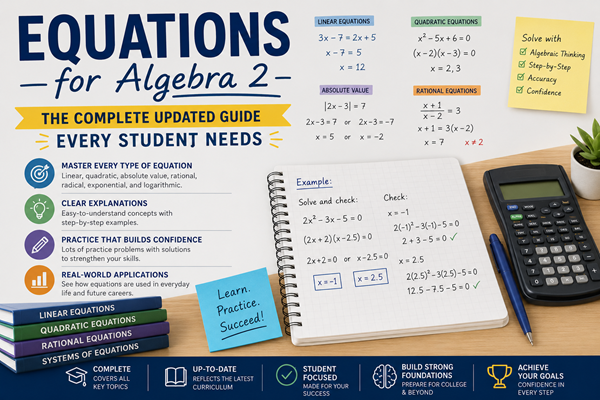
Systems of equations appear throughout Algebra 2, and the complexity ramps up significantly compared to Algebra 1. When solving a system with two linear equations, you are finding where two straight lines meet, which is usually just one point. But with a linear-quadratic system, you are finding where a straight line intersects a curve, and because a line can cut a parabola twice, you often have to find two possible solutions.
The substitution method is the cleanest approach here: isolate one variable in the linear equation, then plug that expression into the quadratic. A common mistake students make is stopping after finding the x-values; a complete solution is an ordered pair (x, y) that satisfies both equations.
For a deeper walkthrough of these methods, visit this systems of equations guide.
Rational Equations: Fractions with Variables
Rational equations contain variables in the denominator, which introduces a critical step most students miss: checking for extraneous solutions. When you multiply both sides by the least common denominator to clear fractions, you might produce a solution that makes the original denominator equal to zero. Those solutions must be discarded.
Algebra 2 rational equation work includes solving rational equations and understanding rational functions through their graphs. The key strategies are simplifying first, finding the LCD, clearing denominators, and then always substituting your answers back into the original equation to verify them.
Exponential and Logarithmic Equations: The Power Pair
These two equation types are inseparable in Algebra 2 because they are inverses of each other. Exponential equations take the form a · b^x = c, and the standard solving strategy is to isolate the exponential term, then apply a logarithm to both sides.
For exponential models, you express the solution to a · b^(ct) = d as a logarithm, and when the base is e, the natural logarithm becomes the tool of choice.
Logarithmic equations require you to apply properties of logs, including the product rule, quotient rule, and power rule, to condense or expand expressions before solving. Algebra 2 students are expected to use the definition of a logarithm to solve equations as well as the one-to-one property of logarithms.
Real-world applications of these equations include population growth models, compound interest, and radioactive decay problems. When a teacher asks you to model something that grows or shrinks at a constant percentage rate, exponential equations are almost always involved.
For a structured review of these concepts, visit this exponential and logarithmic equations resource.
Radical Equations: Isolate, Square, Verify
Radical equations contain variables inside a square root or higher-order root. The approach is straightforward: isolate the radical on one side, then raise both sides to the appropriate power to eliminate it. A critical caution with radical equations is the danger of squaring both sides, which can introduce extraneous solutions.
Just like rational equations, every answer must be checked against the original equation. Students who skip that verification step often mark wrong answers as correct.
FAQ: Equations for Algebra 2
Quadratic equations are the foundation. They connect directly to polynomial behavior, systems of equations, and even complex numbers, so fluency here supports everything else.
Look at the structure of the equation first. If it has a variable in the denominator, it is rational. If the variable is in an exponent, reach for logarithms. If there is a square root around the variable, you are working with a radical equation.
Certain solving steps, like squaring both sides or multiplying by a variable expression, can introduce solutions that satisfy the transformed equation but not the original. Always verify your answers.
They are inverses. Solving an exponential equation uses logarithms, and solving a logarithmic equation uses exponentiation. Understanding one helps you understand the other.
The formula x = (-b ± √(b² – 4ac)) / 2a solves any quadratic equation. Use it when factoring is not obvious or when the problem involves irrational or complex solutions.
Mastering equations for Algebra 2 is less about memorizing formulas and more about recognizing patterns and knowing which tool fits which problem. Work through each equation type deliberately, check your solutions consistently, and use reliable study resources to fill gaps as they appear. For more guides covering every topic in this course, explore the full Algebra 2 study collection.

Leave a Reply